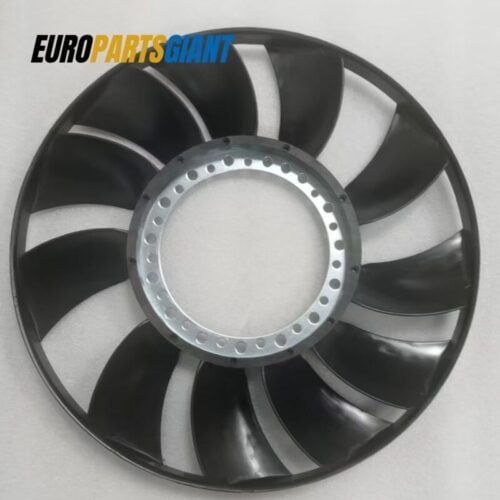
This article offers a deep, technical, and original analysis of the construction (structure) of the OEM Audi 4Z7121301 cooling fan blade. Rather than focusing only on function, we explore how each structural element is designed, how the components work together, and why the construction of 4Z7 121 301 reflects Audi’s strict OEM standards. The content is written for long-term SEO value and does not duplicate existing content found online.
Why the Structural Design of a Cooling Fan Blade Matters
At first glance, a cooling fan blade may appear simple. In reality, it is a rotating aerodynamic component operating in a harsh environment: high heat, constant vibration, moisture, and continuous mechanical stress. Any flaw in structure—whether imbalance, poor material choice, or incorrect blade geometry—can affect not only cooling efficiency but also the lifespan of the fan motor and nearby components.
The OEM Audi 4Z7121301 is engineered as part of a complete cooling system, meaning its structure is optimized to work in harmony with the radiator, fan motor, shroud, and engine management logic. Understanding its construction helps explain why OEM parts consistently outperform generic alternatives.
Overview of the OEM Audi 4Z7121301 Cooling Fan Blade Structure
The 4Z7121301 cooling fan blade is not a single-purpose molded part. Its structure can be understood through several integrated design layers:
Central hub assembly
Blade geometry and curvature
Reinforcement ribs and load distribution zones
Material composition and thermal resistance
Balancing and vibration control features
Each of these elements contributes to the overall stability and performance of the 4Z7 121 301 fan blade.
Central Hub Design: The Structural Core
Precision-Molded Hub Interface
At the center of the OEM Audi 4Z7121301 is a precisely molded hub that connects directly to the fan motor shaft. This hub is designed to meet exact tolerance requirements, ensuring a tight and stable fit without excessive stress on the motor bearings.
The hub structure includes:
Reinforced mounting points
Even weight distribution around the axis
High resistance to rotational shear forces
This design minimizes the risk of wobble or misalignment during high-speed rotation.
Load Transfer and Rotational Stability
The hub of the 4Z7 121 301 acts as the primary load-transfer point, distributing rotational force evenly across all blades. This balanced load transfer is essential for long-term reliability, especially during frequent fan activation cycles in urban driving conditions.
Blade Geometry: Aerodynamics Meets Structural Integrity
Blade Angle and Curvature
One of the most defining structural aspects of the 4Z7121301 cooling fan blade is its blade geometry. Each blade is shaped with a specific angle of attack and curvature designed to move a precise volume of air while minimizing resistance.
The curvature serves multiple purposes:
Maximizing airflow across the radiator
Reducing turbulence at high RPM
Limiting noise generation
This aerodynamic shaping is achieved without compromising structural rigidity.
Uniform Blade Thickness
Unlike aftermarket fan blades that often vary in thickness, the OEM Audi 4Z7 121 301 maintains consistent blade thickness throughout critical stress zones. This uniformity ensures predictable flex behavior under load, preventing micro-cracks that can develop over time in poorly designed components.
Reinforcement Ribs and Structural Support Zones
Integrated Rib Architecture
Hidden beneath the surface of the blades are subtle reinforcement ribs that strengthen the 4Z7121301 without adding unnecessary weight. These ribs are strategically placed along high-stress paths, particularly near the blade root where centrifugal forces are greatest.
This internal reinforcement:
Enhances resistance to deformation
Maintains blade shape at operating speed
Improves long-term fatigue resistance
Stress Distribution Engineering
Audi engineers designed the 4Z7 121 301 fan blade to distribute stress evenly across the entire structure. By avoiding concentrated stress points, the blade can withstand repeated thermal expansion and contraction without structural failure.
Material Composition and Thermal Resistance
High-Grade Composite Materials
The OEM Audi 4Z7121301 cooling fan blade is manufactured from a high-performance composite polymer. This material is selected for its ability to handle:
Continuous exposure to engine bay heat
Rapid temperature changes
Moisture, oil vapor, and contaminants
The composite structure maintains rigidity while allowing controlled flexibility, which is critical for absorbing vibration.
Heat Stability and Aging Resistance
Over time, inferior plastics can become brittle due to heat cycling. The material used in the 4Z7 121 301 is engineered to resist thermal aging, maintaining its mechanical properties even after years of service.
This material stability is a key reason why OEM fan blades often last significantly longer than non-genuine alternatives.
Dynamic Balancing and Vibration Control
Factory Balancing Precision
Every OEM Audi 4Z7121301 fan blade undergoes strict balancing procedures during production. The structural design ensures that mass is evenly distributed across all blades, reducing rotational imbalance.
Balanced construction results in:
Reduced vibration
Lower noise levels
Less wear on fan motor bearings
Noise Suppression Through Structural Design
Beyond balance, the blade edges and surface profiles of the 4Z7 121 301 are designed to minimize air resonance and tonal noise. This contributes to Audi’s signature quiet operation, even when the cooling fan is running at higher speeds.
Integration with the Cooling Fan Assembly
The structure of the 4Z7121301 is designed to work seamlessly with the fan shroud and radiator layout. Blade length, depth, and spacing are calculated to ensure optimal airflow without interference or contact, even under chassis flex or engine movement.
This level of integration is difficult to replicate with aftermarket components that lack access to original design data.
Structural Durability Under Real-World Conditions
The OEM Audi 4Z7 121 301 cooling fan blade is built to handle real-world driving scenarios, including:
Stop-and-go traffic
High ambient temperatures
Prolonged idling
Highway cruising with sudden fan engagement
Its structural design allows it to maintain performance without warping, cracking, or losing balance.
Why Structural Design Makes OEM Parts Worthwhile
While many cooling fan blades may appear similar, the internal structure of the OEM Audi 4Z7121301 sets it apart. Every curve, rib, and material choice is the result of testing and validation under Audi’s engineering standards.
This attention to structural detail translates into:
Predictable cooling performance
Reduced risk of secondary failures
Long-term reliability
Conclusion
The OEM Audi Cooling Fan Blade 4Z7121301 is a carefully engineered component whose structure reflects Audi’s commitment to precision and durability. From the reinforced central hub and aerodynamically optimized blades to the advanced composite materials and balancing features, every element of the 4Z7 121 301 is designed to perform reliably under demanding conditions.
Understanding the construction of this fan blade highlights why genuine OEM components continue to be the preferred choice for maintaining factory-level performance. In the complex environment of modern engine cooling systems, the structural excellence of the 4Z7121301 plays a vital role in ensuring stable temperatures, reduced noise, and long-term mechanical integrity.